

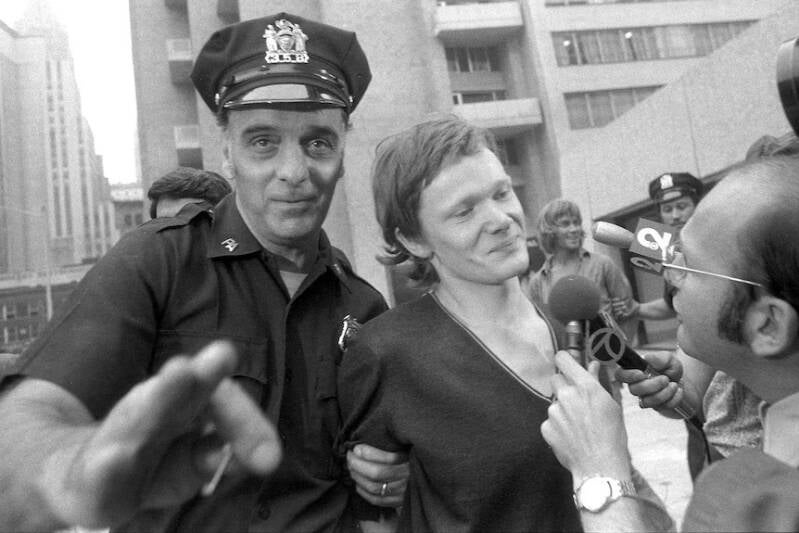
Above: M. Petit, looking not at all dismayed at being arrested by the NYPD – ”all publi is…” (photo: Getty Images: Richard Corkery/NY Daily News Archive)
MMXXVI: originally published 5th June 2026
972 words
꒰༊꒱ ꒰༊꒱ ꒰༊꒱
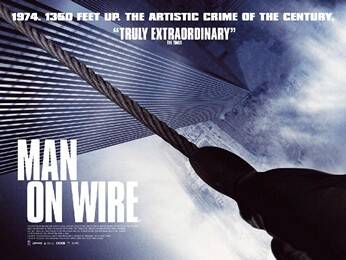
In 1974 French equilibrist Philippe Petit stunned a transfixed morning crowd of New York onlookers and panicked the local police by walking (completely untethered) back and forth across a high-wire strung between the two towers of the barely-completed World Trade Center, 410 metres above the metropolis pavement. This legendary feat, accomplished illegally and surreptitiously—commemorated in the 2008 Academy Award-winning documentary film Man on Wire—has been described as “the artistic crime of the century”.
For decades Petit has propagated the line that he had planned his NYC stellar walk for six years before it happened, even before the Twin Towers building had started construction! More recently, the high-wire artist has come clean that that was just mythmaking by the storyteller in him, admitting it was actually eight months from conception to implementation (‘Highwire walker shares the truth about death-defying Twin Towers stunt’, Flint Duxfield, ABC, 28 August 2024, www.abc.net.au).
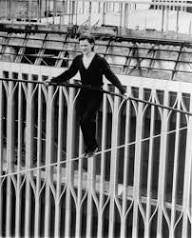
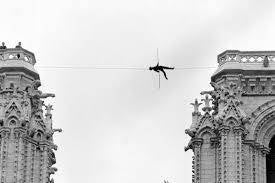
The French artist’s funambulist marvel on the Lower Manhattan skyline was his most audacious, seemingly death wish-motivated skywalk, but it was not his first such venture into the clouds. The tenacious Frenchman has serious form in the stunt caper. Over the three preceding years Petit had several “trial runs” for his 1974 Twin Towers triumph, deliberating selecting iconic global landmarks to maximise publicity. In 1971 the youthful Petit with some help from his friends rigged up a cable between two towers of Notre-Dame de Paris Cathedral. Dressed in trademark black, Philippe set forth on the wire, prancing on tippy-toes 225-feet above the ground, stopping to do tricks, juggling balls, lying down on the cable, etc.
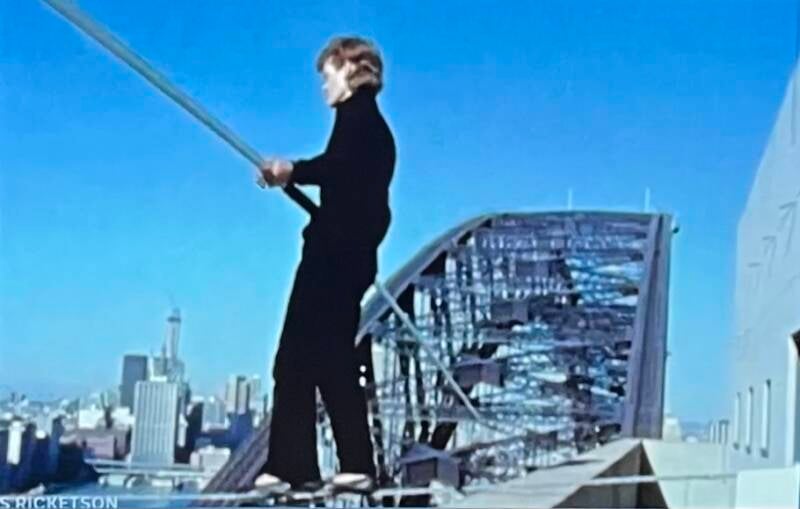
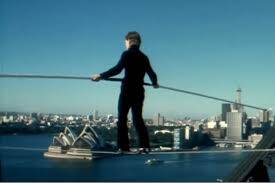
Next up for Philippe was Sydney’s famous Harbour Bridge in 1973. According to Petit, the bridge skywalk (his “miracle”) was undertaken after only three or four days in the harbour city without being pre-planned. Reasoning that in all likelihood he wouldn’t get permission from the local authorities Petit took his customary clandestine approach¹…aided by a small team of French and Australian friends (including future Oz filmmaker James Ricketson) Philippe trespassed unseen onto the harbour bridge infrastructure the night before the attempt, carrying materials including cables and ropes “borrowed” from the construction area up to the roof of one of the northern pylons. From there they managed to connect the cables and ropes to the pylon on the opposite side. On skywalk day Petit performed his “theatre in the air”, crossing unfalteringly between the pylons 142 metres above the water four to six times by his reckoning. All the while Philippe performed his signature routine which he would replicate at the Twin Towers – dancing joyfully on the rope, waving to and saluting the growing crowd of spectators below, lying down on the rope while maintaining his balance and so on. Meanwhile, traffic below on the bridge ground to a halt as motorists stopped to gaze up at Philippe’s show. Petit’s ended his star turn only after the police alarmingly started cutting the safety ropes supporting the wire cable. Forced down to ground level Philippe was arrested and fined $200. Ever the showman, he managed to steal the wristwatch of one of the arresting officers!
The relative ease with which Philippe and his determined team of collaborators were able to penetrate the out-of-bounds precinct of the bridge undetected, speaks volumes for the woeful inadequacy of the site’s security setup…this proved to be even more the case with the Twin Towers project where the team’s seamless, successful passage into and up to the top of the new complex happened right under the noses of (lax) security.
Petit’s fame on the high wire has prompted countless interviews during which the ultimate question always pops up…did he did fear, or perhaps rather, why didn’t he fear falling when he was up in the clouds? Petit always responds to this question with the assurance of unwavering positivity—or is it well-buttressed bravado?—stating that he does not fear it, adding that if he did fear falling at all, he would never attempt it in the first place. A touch of braggadocio there perhaps, but Philippe attributes his unwavering supreme confidence in his ability to succeed down to a process he undergoes, a sort of exercise in constructing a “mental net” below him which envelopes and protects him from falling as he makes the perilous (and for mere mortals, impossible) crossing.
The high-wire ace also ascribes his success to preparation and planning, taking a holistic approach to the challenge at hand – in the lead-up to the Twin Towers spectacular, meticulous research gave him a clear picture of environmental and atmospheric conditions at the location (factoring in variables such as the extent to which the high towers might sway due to wind). Petit was also “hands-on” in the task of ensuring the engineering integrity of the project (creating models; rigging a 60m-long cable across the gap; personally designing the anchor-point, etc.) (‘Philippe Petit’s Sydney Harbour Bridge highwire walk halted went police started ‘cutting the ropes’”, Rosemary Bolger and Richard Glover, ABC Radio Sydney, 28-May-2023, www.abc.net.au).
Endnote: Perhaps surprisingly Petit has no circus background, no formal training or family associations with the world of “Big Top” performing, but started on the journey to a career of acrobatic wizardry by busking as a juggler with both feet firmly planted on Mother Earth. Nonetheless, the über-driven and flamboyant Parisian was born to it, being both quintessential artist and showman – and can talk the talk…listen to any interview with Petit and you’ll see how adept he is at selling himself, strainingly so at times.
🔳🔳🔳🔳🔳🔳🔳🔳🔳🔳🔳🔳🔳🔳🔳
¹ in fact the very illegality of the act is what spurs Petit on, born to be a rule-breaker, a provocateur in defiance of the powers that be
Below: (L) Petit getting horizontal at Notre-Dame de Paris. (Centre) Petit stepping out from that iconic bridge and (R) getting a bird’s eye view of the still to be opened Sydney Opera House (source: James Ricketson)
Below: Philippe, fashionably attired in Seventies’ flares, walking the legendary walk between Twin Towers


Create Your Own Website With Webador