



MMXXVI~originally published 15th June 2026
665 words
☄️ ☄️ ☄️
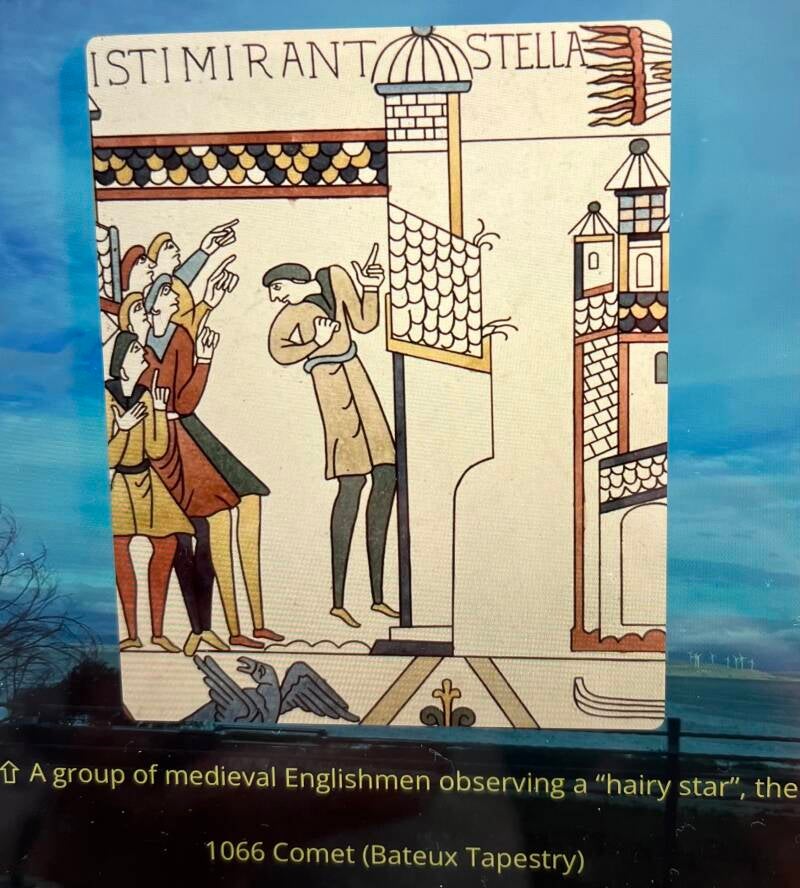
The sight of Halley’s Comet streaking across the sky at particular intervals has profoundly unnerved the world’s populations since ancient times. The earliest confirmed and recorded sighting occurred in China, 240BC…described as a “broom-shaped star”, it was thought to presage the coming of the Qin dynasty’s unification of the Seven Warring States (230–221BC). One of the most famous orbits of Halley’s Comet was observed in the pivotal year, 1066. Ppeople in England took this a portend of what was to happen a few months later, the history-altering defeat of Anglo-Saxon king, Harold II, by Norman duke, William the Conqueror, at the Battle of Hastings.
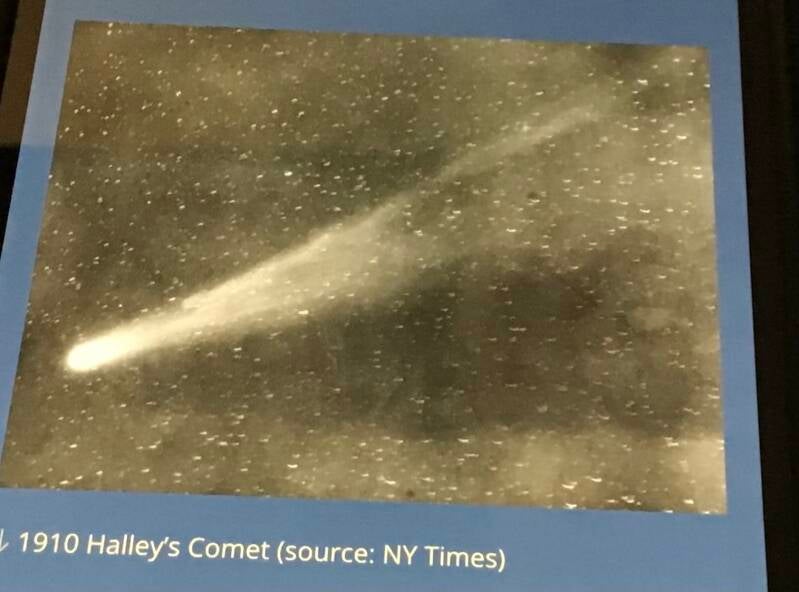
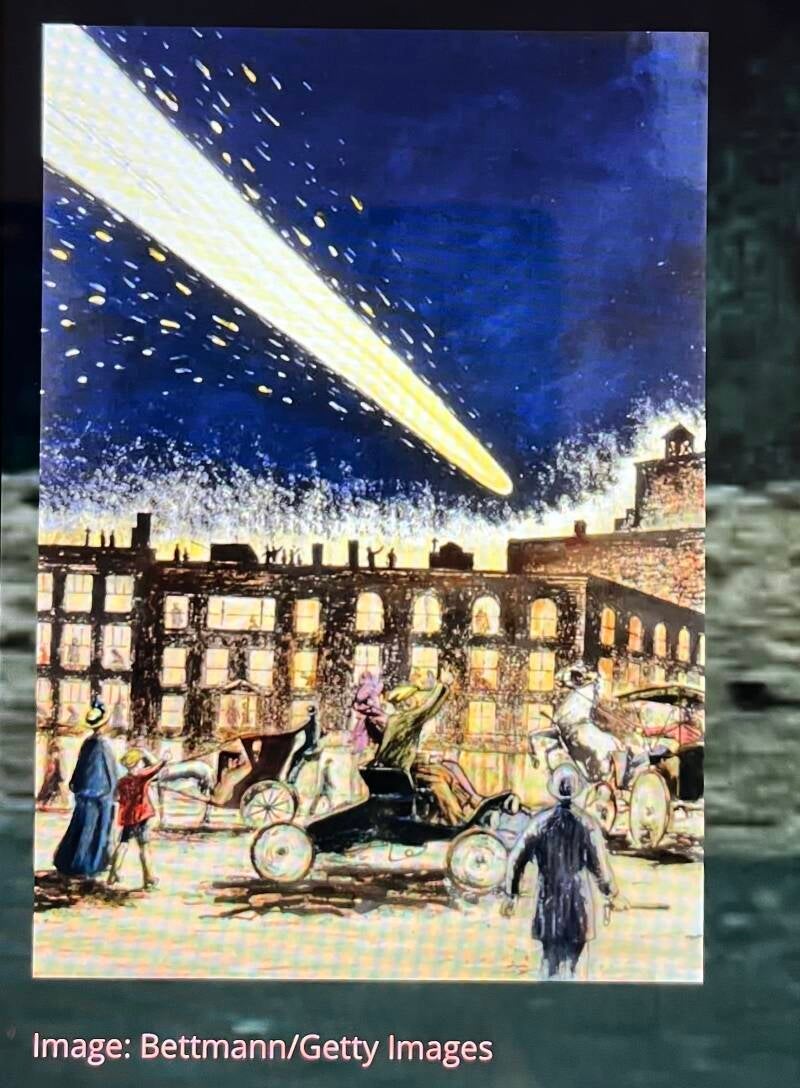
Fast forward to the 20th century and the appearance of Halley’s Comet in 1910, we see the phenomenon’s capacity to generate mass human hysteria and panic reach its apogee. The trigger-point for the outbreak of comet mania in 1910 seems to be the intemperate comments of one French scientist, Camille Flammarion, whose irresponsible speculation was a catalyst for the unfolding drama. Flammarion hypothesised that if the bands of poisonous cyanogen gas within the comet”s tail came into contact with the hydrogen of the Earth’s atmosphere, such a convergence might snuff out all life on the planet(a), not exactly reassuring news for thosedenizens of the world already alarmed by Halley’s imminence.
Newspapers were quick to latch on to the mania of the doomsday scenario with typical headlines such as‘Coming End of World’ (Ogden Standard (Utah), February 9, 1910) and ‘Comet May Kill All Earth Life’ (San pFrancisco Call, February 8, 1910). While there was genuine awe from some observers at the science of it all(b), the perceived doom and gloom overshadowed most discussions. The impending arrival engendered a pervasive pessimism and fatalism among communities – some German farmers didn’t plant crops in Spring as usual, reasoning that they’d be dead by harvest time in any case. In the apocalyptic panic some people defaulted on bank loans, other gave themselves over to Bacchanalian excess in their supposed last days, anda few were driven to commit suicide. Barmen in taverns and pubs got the bright idea of encouraging their patrons to drink scotch or whiskey to excessive levels in the belief it would act as an antidote to the comet’s deadly gases (‘Comet Panic of 1910, Revisited’, Sam Kean, Science History Institute, Museum and Library,www.sciencehistory.org).
Inevitably in such a downcast and surreal climate, the charlatans emerged from the underbelly of capitalism with their sure-fire quick “fixes” for the noxious celestial substances…remedies abounded, pharmacies sold“anti-comet pills” which despite having zero therapeutic properties were lapped up by a spooked public. Equally bogus “anti-comet gas masks and umbrellas” purporting to neutralise the toxicity of the cyanogen flew off the shop shelves.
A number of international events a few months after the comet completed its spectacular orbit around the Sun were put forward by some as supposed confirmation of the ill-tidings portended by the appearance of Halley’s Comet. For Britons this included the death of the UK’s reigning monarch, Edward VII, in May 1910, and on the Korea peninsula, for the former minister of home affairs the comet was a sign foretelling the demise of the imperial Korean dynasty…as it transpired that is what happened in August of that year with the Japanese annexation and colonisation of Korea (‘Daylight Comet of 1910 portends end of Korean dynasty’, The Korea Times, November 10, 2019, www.koreatimes.co.kr).
Endnote: The comet’s name honours British astronomer Edmund Halley who used the framework of Issac Newton’s scientific and mathematical theories to demonstrate that the same bright comet was making periodic orbits of the Solar System, which he calculated occurred roughly every 76 years (in 1705 Halley predicted, correctly, that his eponymous comet would return in 1758).
◘◙◘◙◘◙◘◙◘◙◘◙◘◙◘◙◘◙◘◙◘◙◘◙◘◙◘◙◘◙◘◙◘◙◘
(a) the widening frenzy was further fuelled by the views of another French scientist who speculated that the 1910 comet might cause a massive, simultaneous condensation of water vapour resulting in a global flood of Noah’s Arc proportions
(b) the 1910 Comet was the first in history to be photographed
15 June 2026
Create Your Own Website With Webador