

MMXXVI~originally published 8th July 2026
977 words
🛩️ 🛩️ 🛩️
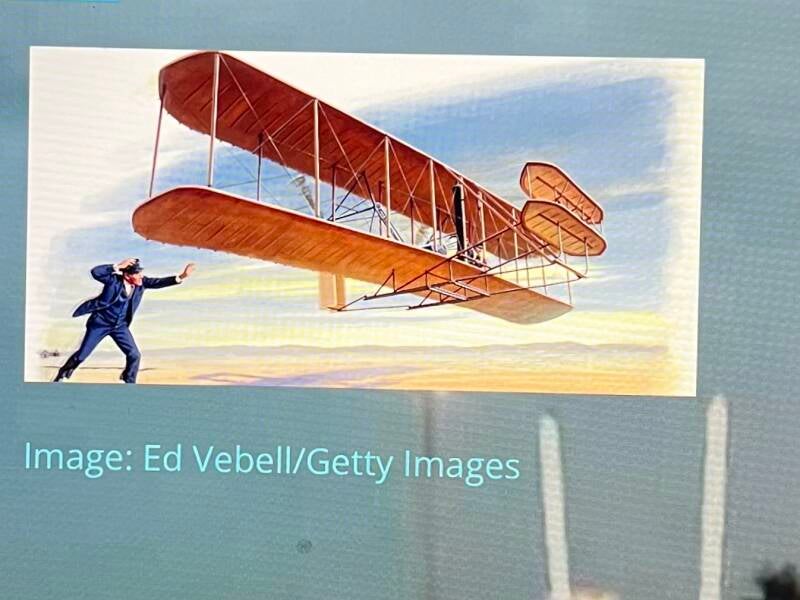
When the word got out to the public and the emerging aviation community that the two brothers Wright had put tiny Kitty Hawk, NC, permanently on the global map in 1903 by (quietly) claiming bragging rights for the first “successful” flight in an air-borne craft, by no means everyone rushed to give them the assenting nod of approval. Doubters at home and abroad were not slow to voice their skepticism.
First off, there were “problems” thrown up by the happenings of December 17, 1903 that transpired, the “team” made four aerial attempts culminating in the 852-feet, 59-second flight above the hills and sandy dunes, an event engulfed by the brothers’ very deliberate low public profile (ie, secrecy). Because of the Wright brothers’ insistence on their attempts at flying remain a secret mission to prevent their designs being stolen, there was no one present to independently and officially witness their epoch-defining flights. The brothers then further generated suspicion by declining to release the iconic photo of the ‘Wright Flyer’ in the air for fully five years after the flight※.
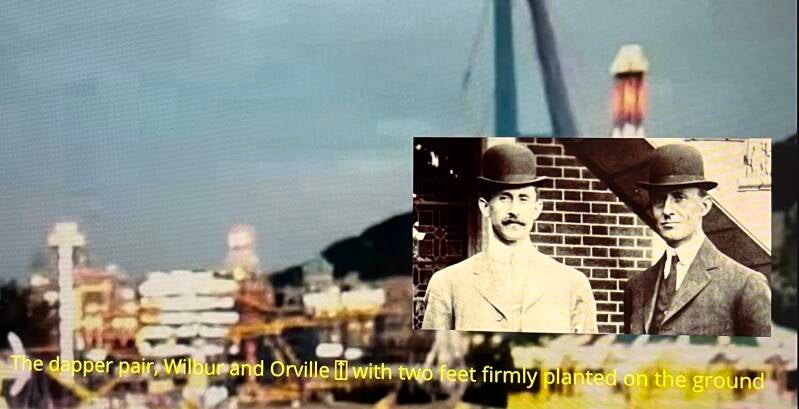
Initially, people tended to scoff at the idea that Wilbur and Orville could pull off such a world-altering miracle of manned, powered flight when many others had failed. After all, the brothers had no engineering or aeronautical qualifications and before turning to the work of designing gliders the pair ran a bicycle sales and repair shop in Dayton, OH. But pivot successfully from bikes to aircraft production they did, thanks to their skills as bicycle mechanics which they applied to the challenges of aerodynamic balance, propulsion, control and lightweight construction [Clive Thompson, ‘Three Design Lessons From the Wright Brothers’, Medium, 15 May 2023, http://clivethompson.medium.com].
At the same time, the pioneering French aviation industry was pushing the candidacy of French-Brazilian aviator Albert Santos-Dumont for primacy over the Wrights. While not disputing that the Wrights may have been “first” in the air, the claim for Santos-Dumont was that his successful flight in a 14-bis bi-plane in 1906 was the first publicly-documented, unassisted take-off using its own power and wheels – unlike the Wrights’ 1903 efforts which required a rail or a catapult to launch. To the French and the Brazilians this makes their aviator, not the brothers, the “true” inventor of heavier-than-air, powered flight.
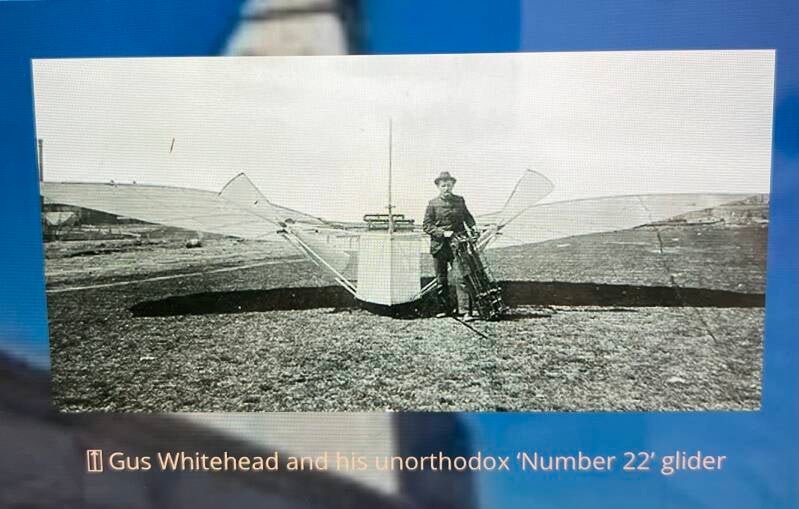
Some American Wrightskeptics long advocated a counter-claim for Connecticut’s Gustave Whitehead, revived again in more recent years by an article in Jane’s All the World’s Aircraft which recognised Whitehead’s 1901 flying attempt as taking precedence over that of the Wrights’. The evidence for the German emigre inventor being first to fly in a heavier-than-air plane however is not based on a secure foundation of proof. The Whitehead claim is undermined by inconvenient weaknesses in his claim – no verifiable witnesses and no letters, diaries or drawings of his aviation experiments have been left🅰. And while there exists some undocumented photographs of Whitehead with his ‘Number 22’ aircraft (and a very grainy photo of something distant in the air which is conclusive of nothing) the visual appearance of the machine with its strange bird or bat-like wings inspires very little confidence of it possessing genuine uplift and aerodynamic stability [Tom Crouch, ‘Yes, the Wright Brothers Really Were the First to Fly’, Smithsonian magazine, Sept. 2013, www.smithsonianmag.com].
The standard definition of what the pioneer aviators were trying to achieve is important here…a sustained, piloted and controlled, powered, heavier-than-air flight. All of the attributes in unison are essential, as for example, New Zealand farmer-cum-inventor Richard Pearce made a brief, powered flight in his country’s South Island in 1903, months before the Kitty Hawk triumph, however it was not controlled with the pilot’s archetype light monoplane ending up lodged high in his own fence!
There were a number of other early aviators contemporary with the Wrights who advanced alternative claims to be considered first in flight, though most of these have drawn little, lasting support. Karl Jatho in Hannover, Germany, is thought to have made attempts in bi-planes and tri-planes prior to Kitty Hawk, but seems to have achieved only longer hops at best and not much in the way of altitude. The German’s claim is also seriously undermined by his having taken 30 years to have it legally certified by original eyewitness accounts. Others include French inventor/engineer Clément Ader’s 1890s experiments with his bat-shaped series of ‘Avion’ flying machines, and American Samuel Pierpont Langley who in the 1890s built an unpiloted engine-driven, heavier-than-air aircraft of substantial size, a successful prototype but flawed by its lack of control in the air.
Hargrave of Stanwell Tops, out of focus for the Wrights: An intriguing aspect of the obsessive and even perverse lengths Orville and Wilbur went to to safeguard their aircraft patents, a trigger propensity to sue at the slightest implied threat to their precious copyrights, is their own lack of reticence in freely borrowing without acknowledging a debt to Australian Lawrence Hargrave’s revolutionary box-kite configurations. Hargrave’s pioneering role in humankind’s aerial conquest has been vastly under-rated – his immense contribution to the Wrights’ breakthrough flights (and to Santos-Dumont’s ‘14-bis’ bi-plane) lies in his development of the cellular box-kite wing, the curved wing surface and the thick (aerofoil) leading wing edge 🅱.
♠♠♠♠♠♠♠♠♠♠♠♠♠♠♠♠♠
※ the French press in particular went in hard against the Wrights’ assertion that they were first in flight, branding them bluffeurs (“bluffers” and “liars”). Until 1908, when the brothers definitively demonstrated their plane’s prowess in France, there was widespread skepticism due to their ongoing secrecy, the refusal to fly their planes in public, the lack of independent witnesses and doubts about the veracity of the famous 1903 photograph
🅰 therefore there are no reproducible results which could demonstrate any genuine advancement of Whitehead’s aircrafts [‘The Case for Gustave Whitehead’, Wright Brothers Aeroplane Company, www.wright-brothers.org]
🅱 the Wrights incorporated Hargrave’s box-kite designs into the construction of their gliders, giving them a greater performance in wing-lift and structural stability
※ 08 July 2026

⍗ Lawrence Hargrave (L), working on his box–kites, south of Sydney, 1890s (source: State Lib of NSW)

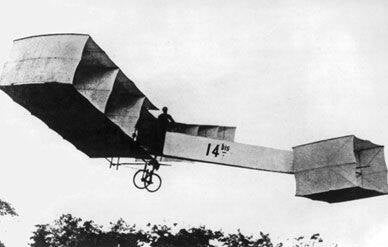
Santos-Dumont’s “tres boxy” 14–bis ⍐ (source: Dan Hagedorn/Smithsonian)


Create Your Own Website With Webador