

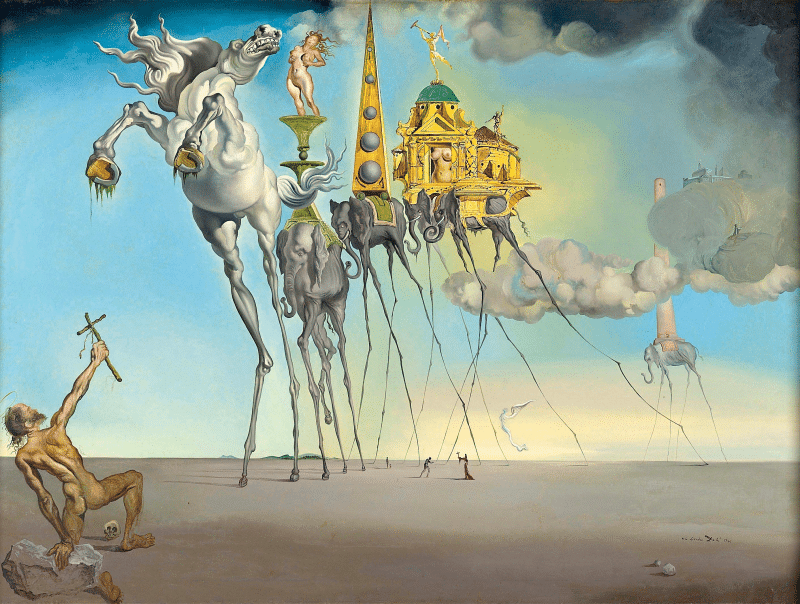
Le Jockey Perdu, (early Magritte, 1926) ➲
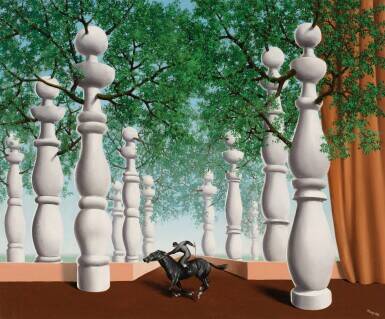
‘ThIs is not a pipe’ (‘Treachery of Images’) (1929) ⇩
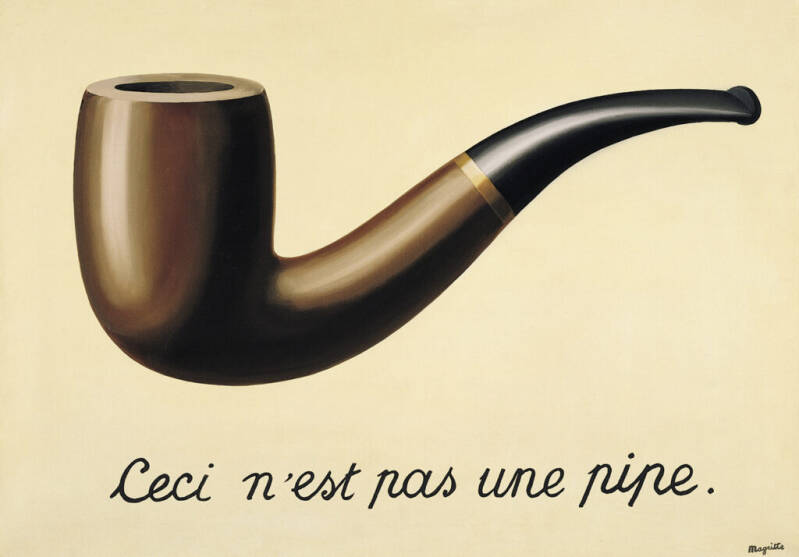
‘Time Transfixed’ (1938) illustrates Magritte’s capacity to startle. Firstly Magritte presents viewers with a fireplace, a conventional symbol of warmth and comfort, but then imposes a hurtling locomotive onto the scene. The loco is the disruptor, crossing the line between the normal and the extraordinary, the familiar and mundane are transcended by a sense of unease and fascination (‘Exploring Time Transfixed by René Magritte’, 10th March 2024, www.singulart.com).
➲
MMXXVI
738 words
🧩 🖼️ 🧩
When it comes to styles and movements of visual art, surrealism equates perfectly with the adage of the casual observer, “I might not know much about art, but I know what I like”. The Surrealists were not every art fancier’s cup of tea but for those who “got it” on some level, it certainly struck an imaginative chord. The movement captured the tenor of the interwar period of the 20th century, with its doubt, anxiety and the unease of a turbulent age. The movement was an attempt to invert a society ruled by conscious thought, Inspired by Freud’s psychoanalytical theories🆇, the Surrealists’ mission was to tap into the unconscious and the subconscious mind, express involuntary thoughts such as dreams, artists explore uncharted depths of imagination hyper-realistic paintings dream-like or nightmarish imagery or strangely incongruous combinations of materials and objects (‘What is Surrealism?’ MoMA, YouTube, 30 Jan 2024).
Whenever the topic of surrealism gets an airing the name of Salvator Dalí inevitably seems to pop up, such was the flamboyant Catalonian’s shameless proclivity to shock and his perverse genius for relentless, over-the-top self-publicity. This piece however will focus on a very different member of the “Surrealist club”, the ever-enigmatic René Magritte, who public persona-wise was a “quiet” surrealist in contrast to the garish and brazen Dalí, but who nonetheless left a impressive imprint on the art world.
A portfolio of pictorial and linguistic puzzles
René Magritte’s art was an assault on the preconceived notions of conventional, mainstream thinking, the Belgian’s stated objective of his art was to “make everyday objects shriek aloud”. Going beyond the idea of objects as simply representational, he took ordinary, familiar things and placed them in uncanny or impossible contexts which challenge people’s perception of reality. Magritte’s canvases are dotted with the usual suspects, a set of familiar objects including blue skies intercut with clouds, seascapes, green apples, pipes, birds and of course the signature black bowler hat🇦, Magritte appropriated these mundane objects to articulate his trademark motifs—“uncanny juxtapositions, trompe l’oeil (“fool the eye”) illusions🇧, distortions of scale (eg, a monstrously large apple filling an entire room), word-paintings and a deadpan realist style”—evoking disturbing works of fantasy tinged with wit (‘René Magritte Belgian, 1898–1967’, MoMA, www.moma.org).
Reality v illusion
When it comes to the question of appraising his oeuvre Magritte seems to belong to the Henry Moore “why limit it to meaning” school. He once said: “When one sees one of my pictures, one asks oneself this simple question, ‘What does it mean?’ It does not mean anything”…for Magritte, the mystery (of the image) was the whole point, not the meaning.
René’s fakes
Magritte had an intriguing side hustle during WWII when he was struggling financially under the Nazi occupation of Belgium, he dabbled in forgeries. Together with a collaborator he forged artworks in the style of Picasso, de Chirico, Ernst and Titian…not restricting himself to paintings Magritte also counterfeited 100-franc banknotes to maintain the necessities of life. This fraudulent practice of copying great masters may not have been entirely for pecuniary gain, art critic George Melly sees the forgery phase as part of the artist’s objective “to bring into disrepute the whole apparatus of bourgeois reality (‘Art Bites: Surrealist Painter René Magritte Was a Master Forger, Too’, Brian Boucher, artnet news, 13 February 2024, www.news.artnet.com). Another observer sees it as “a subversive strategy (the artist) deployed against his own official work, which he simultaneously builds and demolishes, placing the viewer in eternal uncertainty” (‘Magritte, a skillful forger’, Art-Test, Feb 20, 2024, www.art-test.com).
Endnote: Magrittemania Paul McCartney was a big fan of the Belgian Surrealist from the 1960s, buying three of his paintings including the 1966 Le Jeu de Mourre (a green apple with the words "Au Revoir" superimposed on it). The iconic apple inspired the Beatles’ Apple Records venture and provided the company’s logo.
༺𐚁𐚁𐚁𐚁𐚁𐚁𐚁𐚁𐚁𐚁𐚁𐚁༻
🆇 particularly germane to Surrealism among Freudian theories is the concept of the “uncanny”…for the venerable Sigmund the uncanny is located in “the strangeness of the ordinary”, a description which encapsulates much of the rationale of Magritte’s artistic impetus
🇦 often perched on the heads of nondescript fonctionnaires (civil servants)
🇧 in ‘The Human Condition’ Magritte shows an easel holding a painting that seamlessly matches and blocks the real-world view out of a window, making it hard to tell where the canvas stops and the landscape begin (‘The Human Condition, 1933 by Rene Magritte’, www.renemagritte.org)
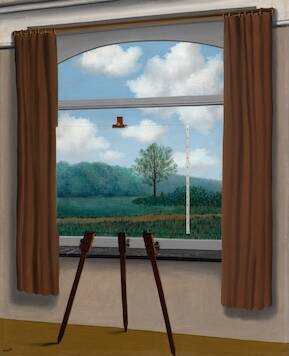
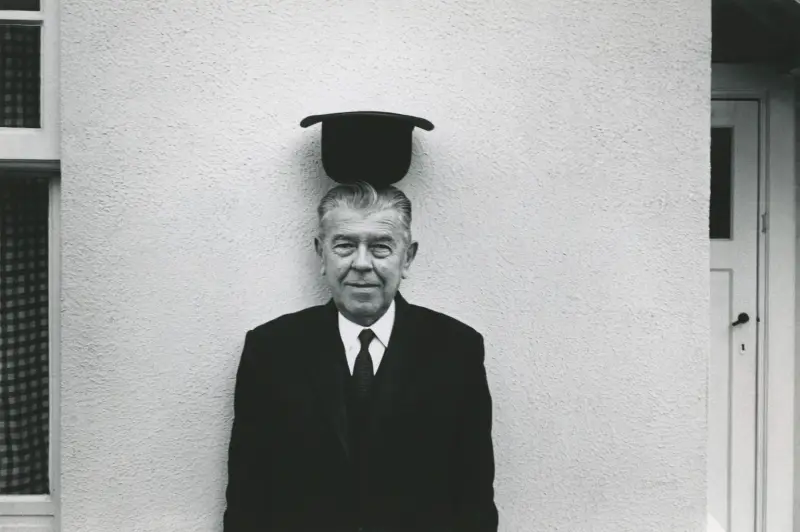
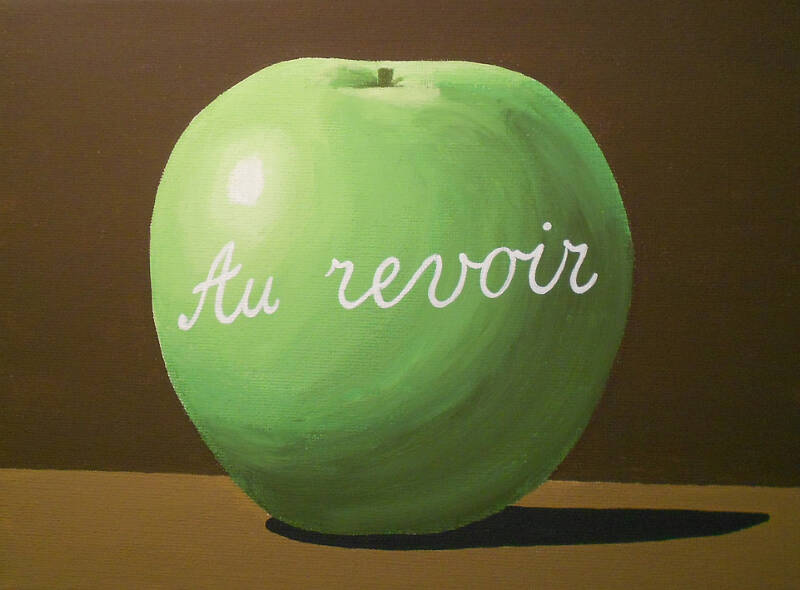
⇧ ‘The Human Condition’ (1933) 🍏🍏🍏 ⇧ Magritte and his upturned world 🍏🍏🍏 ⇧ Le Jeu de Mourre (1966)
‘The Son of Man’ (1964) the ubiquitous green apple concealing the identity of an anonymous civil servant and a seascape ➲
Magritte: “Everything we see hides another thing, we always want to see what is hidden by what we see”
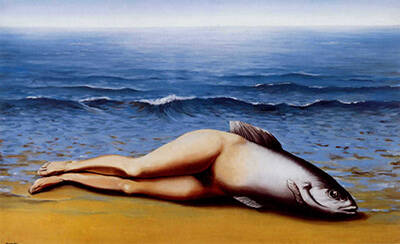
⇚ 'The Collective Invention' (1935): Magritte flips the standard notion of the mermaid on its head (a "reverse mermaid")


Create Your Own Website With Webador