


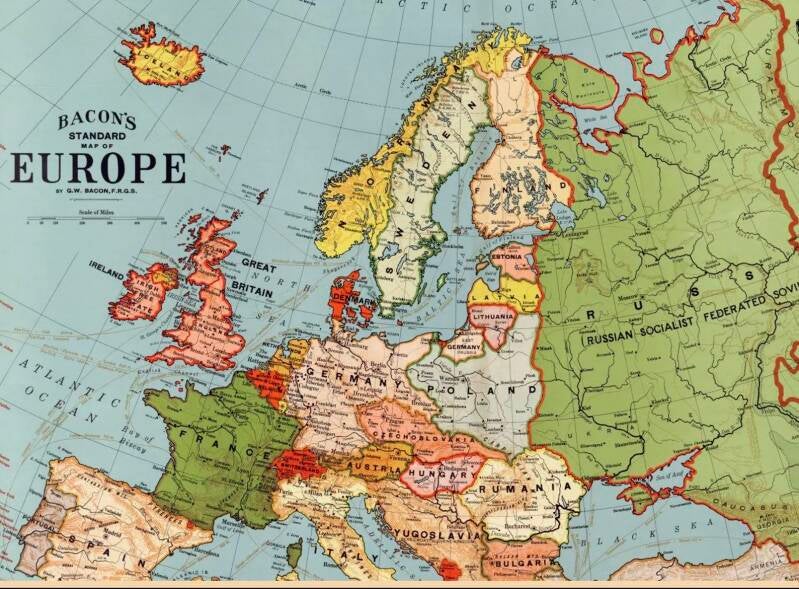
⇓ Europe, 1923 (GW Bacon map)
1150 words
𖤗 𖤗 𖤗
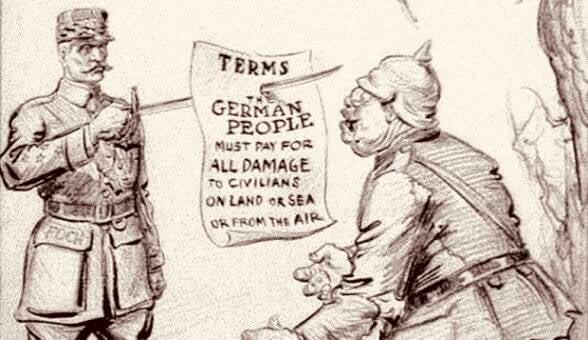
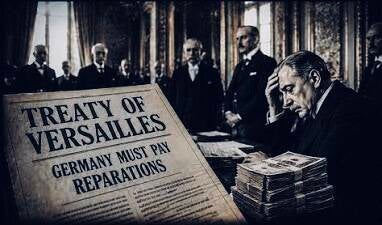
The Treaty of Versailles in 1919 (and the follow-up 1921 London Schedule of Payments) determined that the defeated nations in the First World War (the Central Powers), as the side deemed guilty for the war, pay reparations for all civilian damage caused to the victors. Because of the financial incapacity of Austria, Hungary, Turkey and Bulgaria to pay, the burden fell almost entirely on Germany. The debt was put at 132 millard (ie, billion) gold marks (equivalent at the time to US$33 Bn). Such a stratospheric sum of money demanded though was only a “paper figure”, the Allies didn’t expect Germany to pay it (and knew they couldn’t)…in reality the reparations was structured on a three-tier format, comprising “A”, “B” and “C” bonds. The Allies only ever expected Germany to fork out for the “A” and “B” components, a total of 50 billion marks. The remaining “C” part was for effect, to dupe the Anglo-French public into believing that that the harshest imaginable punishment was being exacted on Germany. Germany’s debt, much revised and reassessed over the course of the 20th century, was finally and legally paid off only in 2010, 92 years after the conclusion of the war to which it pertains! (‘Rebuilding Europe: Reparations’, History Guild, https://historyguild.org).
Most people in the early 21st century would be unaware that these historic reparations, an anachronism from a war occurring in the 1910s was still a live issue…prompting the question, why was this monetary obligation not settled until 2010? From the start there was little chance that even the real sum was going to be paid in any timely manner by a German people who largely believed the treaty unjustly punished the country and it’s citizenry. Germans bitterly resented the amount demanded and even more so the so-called "guilt clause" (Article 231) which allocated Germany responsibility for the global conflict. Accordingly, the Weimar Republic in the 1920s pushed back against the payments burden, paying very little and even halting it altogether in 1923, leading “victor nations” France and Belgium to briefly invade Germany’s Ruhr industrial heartland. Thereafter, there was some recognition of an economically struggling Germany’s capacity the meet it’s obligations by the Allies…the Dawes Plan (1924) and the Young Plan (1929) reduced it’s debt and granted Germany loans to meet its payments. The Wall Street crash of 1929 plunged the world into an unprecedented Depression, making it virtually impossible for Germany to continue the payments, however the debts remained on the books due to the US Congress vetoing a plan to write off almost all of Germany's war debt (‘Why has Germany taken so long to pay off its WWI debt?’, Olivia Lang, BBC News, 2 October 2010, www.bbc.com).
At the time Hitler came to power in Germany, 1933, the country in deep economic crisis had already defaulted on the reparations (Germany by this point had met about one-eighth of it’s financial obligations). The Nazi dictator aggressively and disdainfully voiced both his refusal to pay any reparations and the total rejection of the Versailles rulings. With the Western powers backpedaling into appeasement and acquiescence, this time there was no moves towards economic or military retaliation against German non-compliance.
After World War II, with a restructured Europe taking shape, the Allies took a different approach to the outstanding reparations still owed by the Germans. In lieu of a straight monetary sum, a considerable part of the debt was to be absorbed through payment “in kind”, involving the physical dismantling of German industrial equipment and extraction of industrial assets (with GB, France and the US exploiting the western zone and the USSR the eastern zone). When Germany was divided into two, the Federal Republic of West Germany (BRD) and the Democratic Republic of East Germany (DRD), each were required to take over the reparations payments still owing. How much exactly that was is somewhat speculative as the sums originally agreed to are in obsolete currencies and have been renegotiated and recalculated countless times (‘Who still owes what for the two World Wars?’, Alexandra Gibbs, CNBC, 18 March 2015, www.cnbc.com).
The matter of reparations were further complicated after 1945 as a result of Germany having lost WWII, making it liable—along with Italy and Japan—for reparations for the latter war as well, necessitating revisions of the amounts required to pay off the reparations. This added new layers of complexity to the process – in addition to the accumulated debt to the Allied victors, West Germany had to separately make reparation to Israel and to Holocaust survivors of the Third Reich, and to Greece🅐.
The 1953 London Debt Agreement of 1953 (Londoner Schuldenabkommen), recognising the prevailing Cold War context meant a need to bring stability to BRD’s postwar reconstruction and development, cancelled roughly 50% of the total debt of around 30 Bn Deutsche Marks, reduced to approximately 15 Bn Deutsche Marks…thus giving the BRD free rein to rebuild its industrial base and smoothing the path ultimately to BRD’s national economic miracle known as Wirtschaftswunder. In 1953 West Germany committed to pay back, slowly, some of the bonds on which it had defaulted back in the 1920s, but said that it wouldn't pay everything until the country was reunified east with west. By 1980 BRD had paid off the principal. In 1995, no longer divided, Germany took up the task of settling all its debts. On October 3 2010 (the 20th anniversary of German reunification), after 90-plus years marked by multiple payment plans, broken promises, cancelled debts, hyperinflation, etc, Germany paid off the last instalment of interest on the 1920s bonds🅑, finally settling its World War I reparations (‘German War Reparations (WW I) Financially Ended’, Rens Steenhard, Peace Palace Library, 3 January 2011, https://peacepalacelibrary.nl).
Footnote: Robbing Peter to pay Uncle Sam
There was another compelling reason at the conclusion of WWI for France and Britain to set up a system of reparation payments. Both nations had needed to take out very big international loans in order to bankroll their participation in the war. With the conflict done and dusted, the US was now calling in the loans.
Postscript: Totality of blame
The history of the interwar period in Europe demonstrates to us that the whole idea of singling out a (humiliated and resentful) Germany as the principal instigator of the war and then saddling it with a crippling financial burden, backfired disastrously…it provided a massive boost in political credibility and rallied support for radical right-wing parties in Germany, culminating in Hitler’s rise to power and the prosecution of an increasingly aggressive foreign policy in Europe. Thus modern-day historians have pinpointed Versailles as a key factor in the lead-up to World War II (Lang).
ꇊꇊꇊꇊꇊꇊꇊꇊꇊꇊꇊꇊꇊꇊꇊꇊꇊꇊꇊꇊꇊꇊꇊꇊꇊꇊꇊꇊꇊꇊꇊꇊꇊꇊꇊꇊꇊꇊꇊꇊꇊꇊꇊꇊꇊꇊꇊꇊ
🅐 the reparation sums paid to Israel and Greece did not close the matters as expected, subsequently both these countries made claims for further recompense from Berlin
🅑 €69.9 million
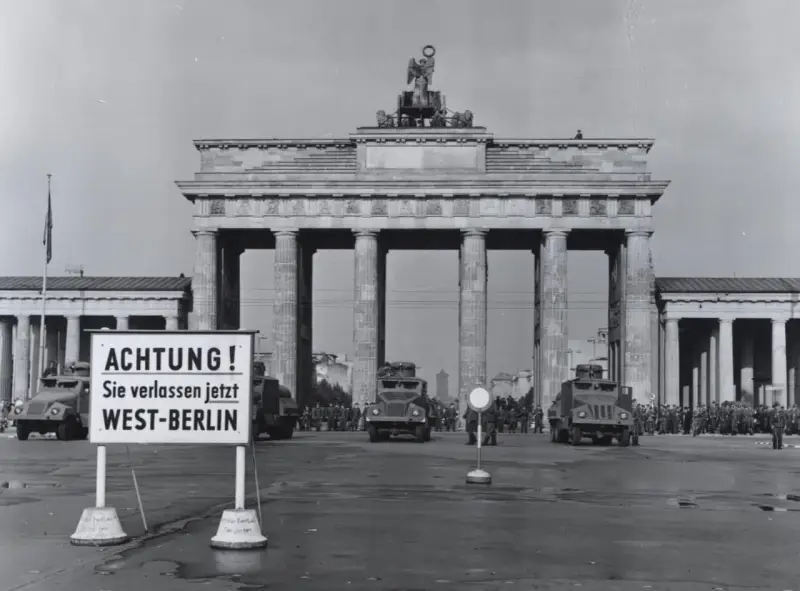
⇓ Brandenburg Gate: East and West Germany
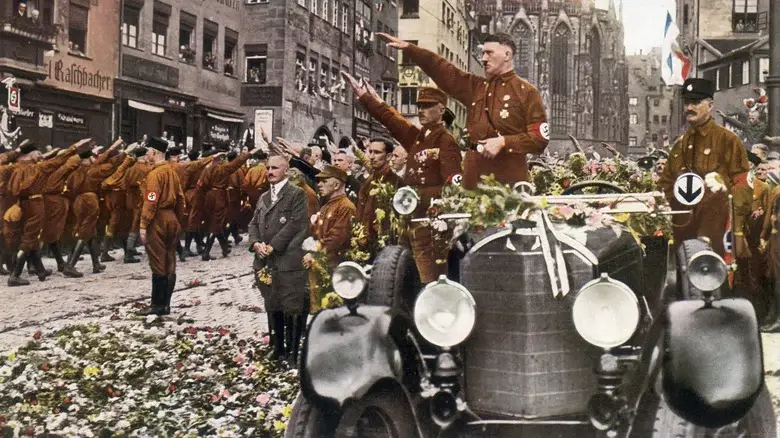
⥣ Adolf Hitler (photo: Hilton Archives/Getty Images)
Create Your Own Website With Webador