

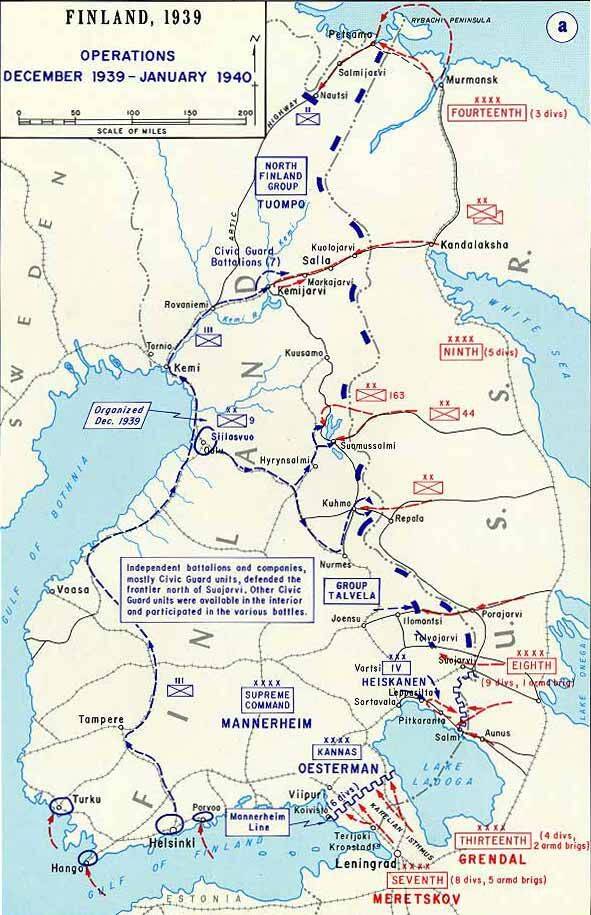
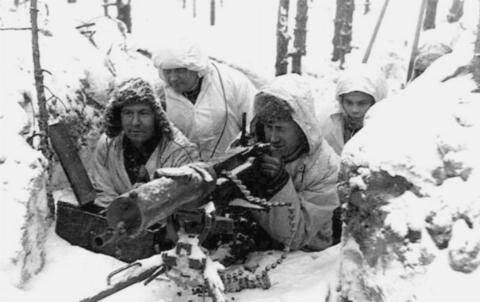
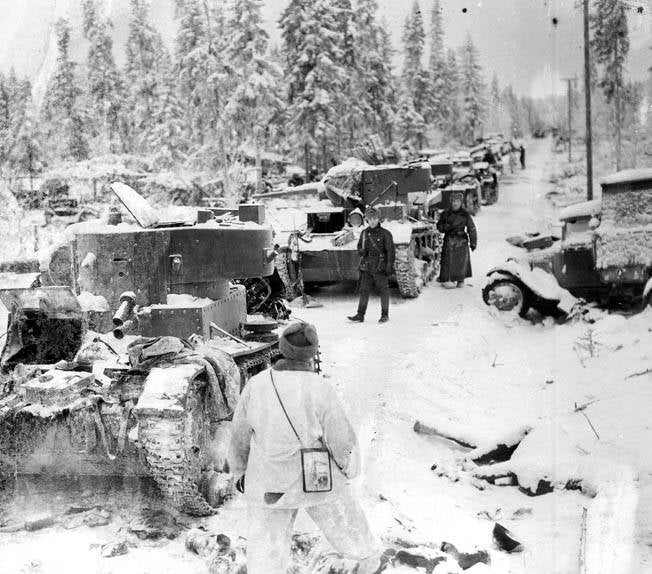
(above) Finnish machine gun crew and (R) captured Soviet tanks in 1939–40 Winter War
760 words
At the end of WWII the victorious Allies levied reparations—either in the form of cash payments and/or assets seizure and forced labour—on the defeated Axis Powers, Germany, Italy and Japan. This chapter of military history is commonly known, but unbeknown to many who take an interest in the global conflict to end all global conflicts, Finland, located on the periphery of events, well outside of the main theatres of war of WWII, was also ensnared by the reparations process. It’s involvement stems from the nation’s entanglement in an ongoing confrontation with its large Soviet neighbour prior to and during the war.
Basically this situation arose because the Soviet Union saw Finland’s proximity as a source of national insecurity which needed to be addressed, and as a corollary, an opportunity for imperial expansion. Also figuring in Soviet planning was Russia’s vulnerability to attack in the event of a future Nazi-Finnish pact. At the beginning of the World War, the Finnish border was a mere 32 km away from the USSR’s key city of Leningrad (St Petersburg). Hitler had signalled that Germany would not contest the USSR’s hegemony over the Baltic region, facilitating Soviet leader Stalin’s objective of gaining control over strategic areas of eastern Finland𝟙 (creating a buffer zone for Leningrad). Diplomacy didn’t persuade the Finns to acquiesce to these demands, so Stalin elected to resort to force.
Winter War 1939–40
The Soviets fabricated a false flag scenario which alleged that Finland had fired on a Russian border post, giving them a pretext to invade𝟛. The militarily-far superior Red Army attacked Finland’s Karelian Isthmus and the city of Viipuri, countered by the smaller Finnish army which fiercely defended its territory and inflicted heavy losses on the Soviet military which had entered the war inadequately prepared. With no support forthcoming from Britain and France, Finland however was forced to make peace on Russian terms – ceding western Karelia to Moscow𝟚 and allowing it to construct a Soviet naval base on Hanko Peninsula.
The Continuation War 1941–44
The territorial security for the USSR gained in the Winter War was placed in peril with the break-up of the Soviet–Nazi Pact. Germany immediately launched it’s invasion of the USSR having forged an alliance with Finland…the Russians responded with air raids on Finnish cities, prompting Finland qto declare war on the Soviet Union and to allow German troops onto it’s soil. Motivation for Helsinki’s declaration is complex, but part of it’s agenda appears to be a desire to regain lost territory and even extend it’s possessions to include eastern Karelia, inspired by Finnish president Risto Ryti’s stated vision of a “Greater Finland”. With its new German allies the Finnish troops drove south, recapturing its forfeited Karelian territory and participating in the Nazis’ siege of Leningrad. The Soviets launched a massive counter-offensive against Finland in 1944, recapturing Viipuri and east Karelia…when the Nazi eastern campaign against the USSR collapsed and the Germans’ materiel supply to their Finnish ally was cut off, Finland was in no shape to continue the war.
Moscow Armistice 1944
Finland again submitted to a one-sided treaty with the Soviet Union and was made to pay reparations, being adjudged partially responsible for the Continuation War. The harsh penalties imposed on the Finns comprised a cash payment of US$300 M (= US$6.9 Bn in 2025 money), to be paid in part by an extensive catalog of physical assets to be signed over to the USSR; reversion of the Russo–Finnish border to that of the 1940 treaty; ceding the municipality of Petsamo to the Soviets; the expulsion of German military from Finland.
Lapland War 1944
This last condition, removing German Wehrmacht forces from Finland provoked another war in Finland’s northernmost region. Under pressure from the Russians to meet its armistice requirement, the Finns initiated an offensive against the remaining Nazi forces in their country. The Germans fought back and while organising their withdrawal to Nazi-occupied Norway, they conducted a delaying, “scorched earth” strategy across the Finnish countryside.
Postscript: Finland and the Soviet Union went on to sign a treaty of friendship and mutual cooperation in 1948, beginning an arrangement characterised in the West as “Finlandisation” – Finland adopted a position of accommodation with Moscow (did not join Western alliances (EU, NATO), didn’t criticise Soviet foreign policy, etc), in return the superpower USSR didn’t occupy or absorb “little Finland”, allowing it to maintain a market economy and democratic system.
☡☡☡☡☡☡☡☡☡☡☡☡☡☡☡☡☡☡☡☡☡☡☡☡☡☡☡☡☡☡
𝟙 as well as over the three Baltic states to the west of Russia
𝟚 Losing 10% of Finnish land in all
𝟛 all plausible evidence points to the Soviets as being the instigators
🇫🇮 🇫🇮 🇫🇮
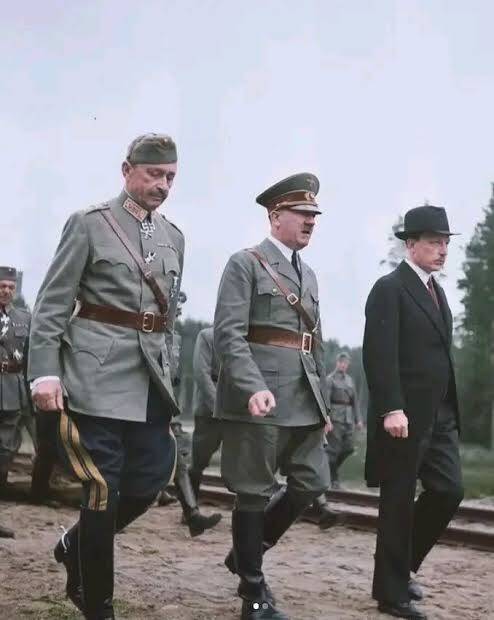
(below) Hitler with Finnish Chief of Defence Marshal Mannerheim (L)
Create Your Own Website With Webador