


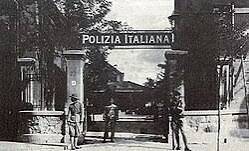
⇧ Italian Concession in Tianjin
Peking legation quarter 🡇↓🠟

733 words
🇮🇹 🇨🇳 🇯🇵
Italy’s calamitous military campaigns in Greece, North Africa and the Eastern Front during World War II and the Allies’ invasion of Sicily precipitated a massive loss in confidence by Italians in their fascist leader, Benito Mussolini, culminating in King Victor Emmanuel III’s dismissal and imprisonment of Il Duce in 1943. In September Italy declared war on Nazi Germany and abruptly switched its allegiances to the Allies’ side. Germany responded by invading northern and central Italy and freeing Mussolini, resurrecting him as the head of a puppet regime in the north of the country, the Italian Social Republic, better known as the Republic of Saló.
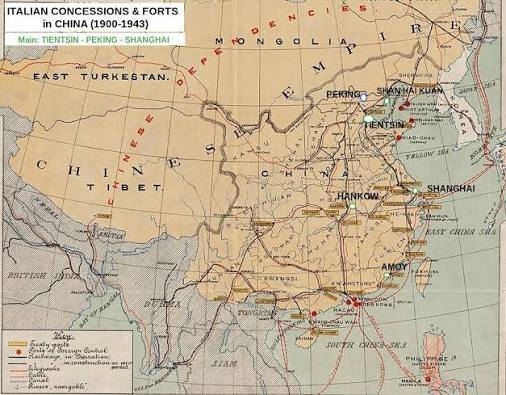
When Italy defected from the Axis tri–powers it’s countrymen and women residing in Japanese–controlled parts of China were in an invidious position, finding themselves in clear and present danger from Japanese retribution. Japan’s response to Italy changing sides—in it’s eyes an act of “betrayal”—was to directly attack the Italian Concessions, it’s possessions and military bases in China§. With overwhelming manpower and weaponry the Japanese military forced the majority of Italian garrisons to surrender in short order. A small Italian garrison of about 100 troops in Peking (legation and radio station), despite being outnumbered ten to one by the invading force, briefly held out before giving up. A similar conflict occurred in Tianjin where 600 to 700-odd Italian soldiers and seamen were pitted against approximately 6,000 Japanese troops, 15 tanks, two gunboats, heavy artillery and aerial support. The lightly-armed Italian defenders made a valiant but futile effort to protect the Italian population and it’s possessions in the city, but their CO surrendered after resisting for 24 hours to avoid any further bloodshed. The captured Italians were given a choice of either swearing allegiance to Japan’s ally RSI (Italian Social Republic) or being interned within Japan’s imperial territories. A minority of Italian soldiers and sailors (known as the “Cooperators”) chose to align with the puppet state, therefore avoiding a brutal POW confinement.
The Japanese launched other acts of aggression against it’s new de facto enemy…including raiding the Italian Embassy in Tokyo and attacking the Italian Concession of Shan Hai Kwan Fort (Shanhai Pass), a pass located where the Great Wall of China meets the Bohai Sea, lightly defended by a tiny force of Italian personnel and easily taken by the Japanese force.
Japan also targeted Italian naval vessels stationed in the Far East, capturing a fleet of Italian submarines. The Japanese were prevented from doing the same with Italian warships moored in East Asian ports…the ships either made a timely escape to the Indian Ocean or were scuttled by their own Italian crews before the Japanese could commandeer them.
The new state of war between the Kingdom of Italy and the Empire of Japan posed a threat to Italian nationals residing in South–East Asian countries as well. In Malaysia and Singapore the Kempeitai (Japanese military police) interrogated Italian civilians, merchants and naval crews, anyone who didn’t pledge loyalty to Saló found themselves dispatched to harsh civilian internment camps such as the notorious Changi Prison. In the Dutch East Indies the Japanese military command in Java and Sumatra moved swiftly to disarm and secure all Italian nationals…those opposing the fascist authority in Italy were held in overcrowded internment camps and subjected to forced labour, starvation diets and violence. Thailand was technically an ally of Japan, the occupying Japanese still nonetheless rounded up and interned members of the Italian legation in Bangkok who remained loyal to the king of Italy.
Within 18 months Japan’s fortunes had swung 180 degrees, it’s military was on the back-foot and forced to desperately defend it’s home islands from the unrelenting Allied offensive in the Pacific. In July 1945 the provisional Italian government belatedly declared war on Japan, however the double US atomic bomb drop on Japan just weeks later which ended the world war pre-exempted any plans the Italians had to engage in military action against Japan. Italy, bankrupt and devastated at the war’s conclusion, had hoped to gain a seat at the San Francisco Peace Conference to present it’s claims for reparations from Japan, however it was blocked from participating and had to wait till 1951 to sign a separate peace treaty with Tokyo.
▬▭▬▭▬▭▬▭▬▬▭▬▭▬▭▬▭▬
§ Japan had previously pressed Rome in 1940 to cede China’s Italian Concessions to Japan’s puppet states, so the timely Italian defection provided an opportunity to realise those objectives

⇧ Tientsin, map (former name of Tianjin)
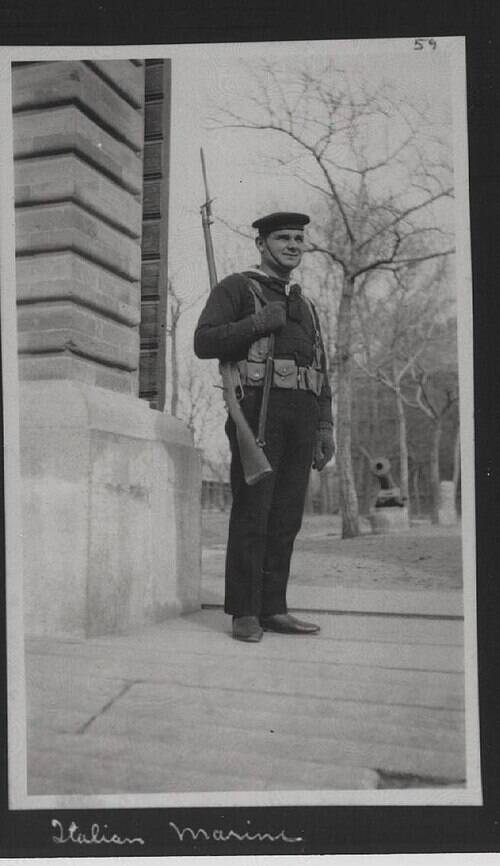
⇧ Italian marine in one of the concessions in China
Create Your Own Website With Webador